Dashboards & Data
A dashboard per asset class — private credit, infrastructure, real estate and more — with market environment scores showing when conditions favour deployment.
The question the dashboard answers
Not 'is this a good fund?' — that's fund selection, and it depends on manager skill, track record, terms. The dashboard answers a different question: is now a good time to deploy into this asset class?
It's a macro timing signal. Entry conditions, not fund selection. The two questions are related but separate. A great fund in bad macro conditions still has a headwind. A mediocre fund in ideal conditions gets a tailwind. The dashboard tells you which environment you're in.
Private markets illiquidity makes timing matter more, not less. Once you're in, you're in for 5-10 years. Getting the entry environment right is one of the few levers you actually control.
One dashboard per asset class
Each major private markets asset class has its own dashboard, its own factor model, and its own signal. The macro conditions that matter for private credit are different from those that matter for infrastructure or natural resources.
The six dashboards currently built: Private Credit, Infrastructure, Private Equity, Real Estate, Hedge Funds, Natural Resources.
Start with the asset classes you're actually deploying into. A dashboard you don't use is just noise. Build what's relevant to your current process.
How the score works
Each asset class has between 4 and 9 macro factors — the conditions that historically correlate with strong or poor outcomes in that market. For private credit, that might include credit spreads, yield curves, and lending standards. For infrastructure, it's more about inflation, real rates, and the policy environment.
Each factor is scored 0-100 as a percentile rank versus its own 20-year history. A factor at 80 means conditions are better than 80% of all months in the past 20 years. Factors are weighted by their importance to that asset class and combined into a single composite score.
Score: 0 = worst conditions ever seen (20-year low)
Score: 100 = best conditions ever seen (20-year high)

Each factor: percentile rank vs 20-year history
Composite: weighted average across 4-9 factors
Updated: weekly (daily data), monthly (yield inputs)
Percentile ranking matters because it makes conditions comparable across time and across asset classes. A 'wide' credit spread in 2024 means something different than a 'wide' spread in 2008. The percentile normalises that.
The signal thresholds
Three zones, each with a clear action signal:
Green  (≥ 65)  — Deploy. Conditions are favourable.
                   Historical win rate for this asset class is high.

Amber  (35-64) — Selective. Be cautious. Look for exceptional
                   opportunities but don't deploy broadly.

Red    (< 35)  — Wait. Macro conditions are working against you.
This isn't the time to commit new capital.The thresholds are backed by backtests against liquid proxy indices for each asset class. They're calibrated, not arbitrary. But treat them as a framework — not as a mechanical rule that overrides judgement.
The hurdle rate model
The score tells you when. The hurdle rate tells you if the return justifies the illiquidity. The formula is simple: risk-free rate + illiquidity premium = minimum net return required.
Three currencies (USD, EUR, GBP). Adjustable illiquidity premium per asset class — higher for private equity, lower for direct lending. The output is a three-part table:
What you need:
  USD: 4.3% (risk-free) + 3.5% (illiquidity) = 7.8% net
  EUR: 2.6% + 3.5% = 6.1% net
  GBP: 4.1% + 3.5% = 7.6% net

What you keep (after FX hedge cost):
  USD → GBP: 7.8% − 0.4% = 7.4% net GBP equivalent
  EUR → GBP: 6.1% + 0.6% = 6.7% net GBP equivalent

Does it clear your bar?
  Fund target: 9% net USD → 8.6% net GBP equivalent ✓
  Fund target: 7% net EUR → 7.7% net GBP equivalent ✓
Most LPs evaluate fund returns in the fund's base currency, then worry about FX later. The hurdle rate model forces you to answer the FX question before you commit, not after.
The data sources
All macro factors sourced from public data — central bank releases, government statistics, market data providers. Weekly automated refresh for price-based factors. Monthly refresh for yield inputs.
No Bloomberg terminal required. Everything the dashboard runs on is freely available.
The edge isn't in proprietary data. It's in the framework — knowing which factors matter, how to weight them, and what the historical distribution looks like. That's buildable with free data.
What it can't do
Doesn't pick funds. Doesn't predict manager blowups. Can't see inside individual portfolios. Doesn't know your specific mandate, concentration, or vintage exposure.
It answers one question: when to deploy capital into a private markets asset class. Everything else — which fund, how much, with whom — is still on you.
The dashboard is a tool for timing decisions, not a substitute for DD. Use it to frame the macro environment. Use your judgement and the wiki for everything else.
How to build it
I'm documenting the build as I go on LinkedIn. If you want to follow the technical side — the data sources, the factor models, how the scores are calculated — follow me there and I'll share. I'll prioritise what gets written up based on what people actually want to know.
Example — Private Credit Dashboard
I've been writing about private credit stress for a while — NII coverage declining across BDCs, spreads historically tight, the asset class showing real cracks beneath the surface. This post covers the NII coverage deterioration in detail.
The dashboard reflects that tension: score is 64.4 — SELECTIVE. Spreads are historically tight (bearish for new entry) but BDC income yield is at the 91st percentile of its own history — income is still compensating even where spread entry isn't cheap. Not a red light, but the model is cautious for good reason.
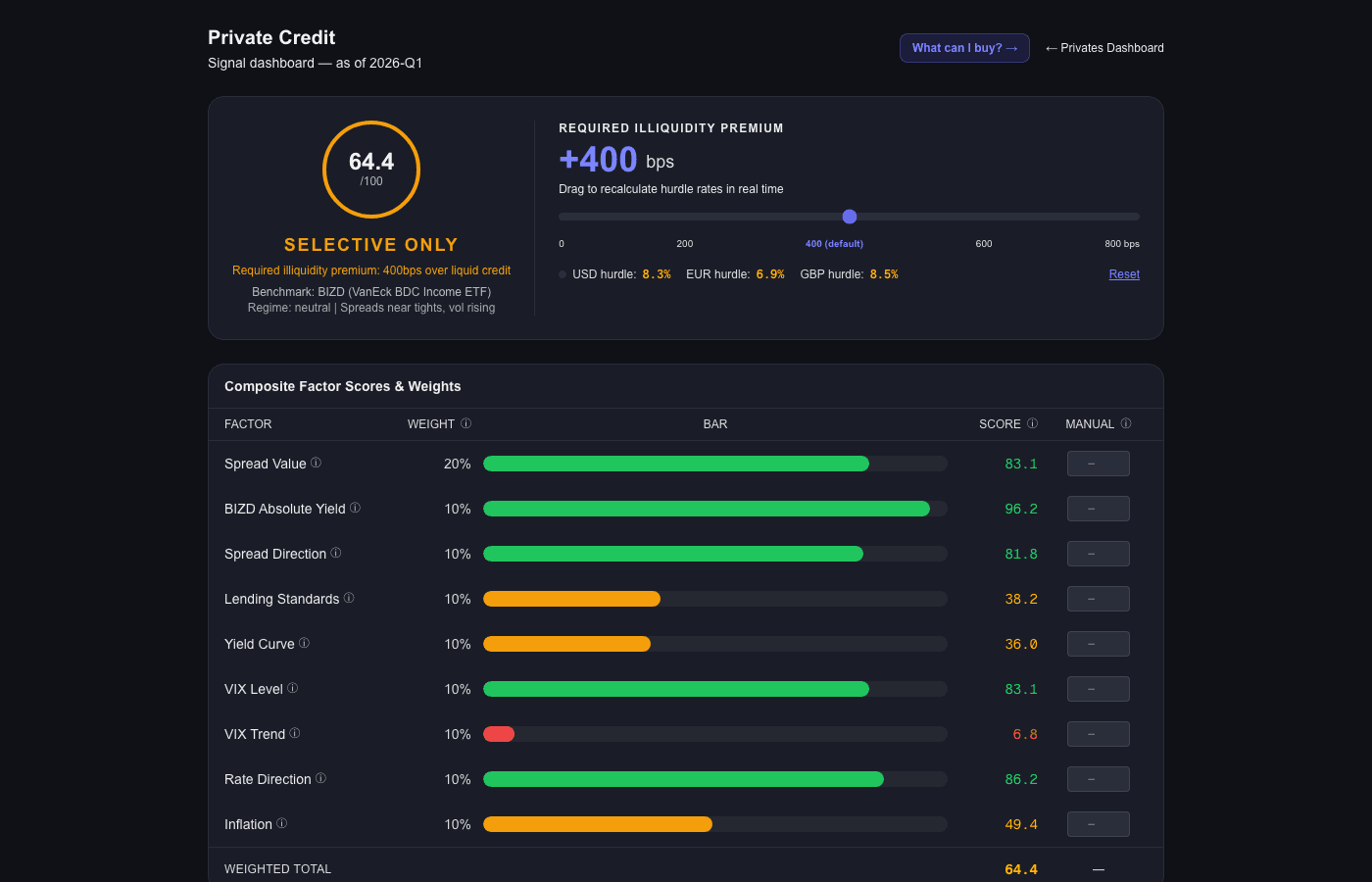
The investor view (not shown) lists comparable instruments across public ETFs, listed BDCs, and private credit funds — all grouped by investor currency, with current yields and 1/3-year returns. Fund names are anonymised in this example.